Definition of dialogue

The aim of a dialogue is to increase understanding about the issues to be discussed, about other people and about oneself. Dialogue is an inalienable core of democracy, which strengthens everyone’s inclusion, equality and freedom.

Immediate objectives of National Dialogues

  • Provide all people living in Finland and Finns living abroad with opportunities to gather together and discuss important issues in a constructive and open manner.
  • Through the participants’ experiences, build an understanding that benefits the public administration and other actors as well as an up-to-date situational picture of various social phenomena, challenges and opportunities.

Wider impacts to be pursued to strengthen democracy

  • To increase mutual trust between citizens, trust between public administration and citizens, and trust between different actors in society.
  • Empower citizens by offering them low-threshold opportunities to participate in social debate and also involving those groups whose voice is not normally heard.
  • To develop the ability of different actors in society to handle matters through dialogue.

Topic selection of dialogues

Dialogues are organised on topics for which a deeper understanding is needed in Finland and that concern a broad range of citizens at the national level. The topic of the dialogue and the way it is addressed must not exclude any particular group of people. In addition, the topic should be such that a broader understanding of it also benefits public administration. In this way, the dialogues can also have an impact on the development of society.

The selection of the topic and the process of the National Dialogue are illustrated in the figure below.

National Dialogue Process
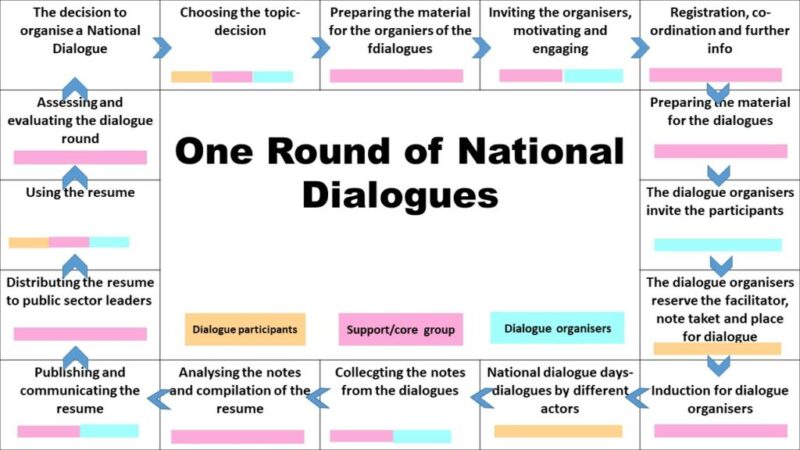
Inviting and Engaging Dialogue Organisers

The core group prepares supporting materials for each topic.

Some dialogue organisers hold dialogues every round of the National Dialogues, regardless of the topic.

The core group determines the key and new target groups for each topic and strives to involve as many different actors and groups as possible as dialogue organisers. The core group contacts stakeholders through various means, prioritising personal contact, such as by phone or email.

Anyone interested can organise a National Dialogue, including civil society organisations, public sector organisations, foundations, companies, or private individuals.

Coordination of Registration

The operative core group receives registrations, and the registered dialogue organisers are listed on the “Participate” event pages.

Training

The core group plans the training and prepares training materials for dialogue organisers. Two to three sessions are held per dialogue day for each round, and all dialogue organisers may participate. The training lasts 2–3 hours and includes guidance on inviting participants, the dialogue script, and a review of the topic. The aim is to make dialogue organisers feel safe and confident about the dialogue and to answer any questions they may have.

From Dialogue Notes to a National Summary

Collection of Dialogue Notes

The core group receives the notes of the dialogues.

Submitting the notes for the summary increases the impact of the dialogues, as they affect the content of the national summary of that year and, through this, all the development projects and actors that intend to utilise the summary in their work.

Compilation and Publication of the Summary

The team operating in connection with the core group analyses the notes and writes the first version of the national summary report, which is then sent to the core group for comments. After this, the summary is finalised.

As a rule, the notes from National Dialogues form interesting material on the topic being discussed and on dialogue, and their potential use as research material may also be considered.

The summary is published on this website under the news section. Information about the summary is shared with dialogue organisers and distributed through the communication channels of the core group and the permanent dialogue organisers.

The summaries are translated into Swedish and English when possible. Depending on the subject of the dialogue, translations into other languages may also be produced.

Evaluation of the Dialogue Round

Transmission of the Summary to Central and Local Government

The core group ensures that the summary reaches the relevant actors in central and local government administration. The core group aims to share the summary as widely as possible with different actors and to collect feedback on it. The core group follows whether the summary serves as an input into significant national reforms or legislative development. Feedback on the functioning of National Dialogues is collected in order to assess the impact of the activities, for example in the development of legislation and other reforms.

Communications

The aim of communications related to National Dialogues is to encourage the organisation of dialogues and participation in them. Building awareness is important so that National Dialogues become an operating model that unites Finland as a whole and Finns living abroad.

Dialogue organisers are encouraged to communicate as much as possible about the dialogues. The core group supports this through content and materials. The aim is also to reach target groups that are otherwise difficult to engage, and organisers are encouraged to consider suitable communication channels for this purpose.